
In his book Letters to Malcom, C.S. Lewis writes about adoration. Not Eucharistic adoration practiced among some Roman Catholics, but the “experience” of “the tiny theophany” in everyday enjoyment and pleasure. The sweet air that whispers of the country from whence it blows, the heavenly fruit that is redolent of the orchard in which it grew. But all of this in the small experiences of daily life.
Adoration is something that we Christians aren’t very good at. Or, at the least, it’s not something that we practice all that often. As I wrote above, Roman Catholics have Eucharistic adoration, and although it’s on the rise (at least from what I hear), it’s not something that every Catholic seeks out. We Western Christians in general might find some sense of joy in looking at stained glass windows, or in singing hymns, or in the reception of the Eucharist, but we don’t usually think of these things as ways to adore God.
One can certainly adore God in prayer. This type of prayer isn’t usually verbal prayer like intercessionary prayer or liturgical prayer that uses lots of words. Adoration is simply looking towards God spiritually and expressing love. We do this pretty often in our secular lives, such as when we simply watch our children playing, or when we look down at a beautiful plate of food and breathe in its delicious scent before chowing down. We usually use the word “relish” to talk about these things, such as “to relish the taste” of a good steak or “to relish our time together.” What we are doing, however, is adoring what little things (or huge and important things) that are before us.
We often pray prayers of adoration in contemplative prayer. As Christians, we don’t seek simply to empty our minds and quell our desires as some Buddhists (especially Zen Buddhists) do. We empty ourselves in order that we might be filled with the Holy Spirit. In other words, emptiness is not the goal; the goal is to be filled, just not with ourselves (and especially our worries). Instead, we turn our attention to God, then sometimes listen, sometimes seek, and sometimes just keep our attention on the personhood of God. For me, that feels like turning my attention or my spiritual heart in a particular direction. It sounds odd, but to me it’s often up and to the left. I close my eyes, let my running thoughts die down, and then direction my attention towards a sort of unseen light in my heart. And for whatever reason the direction of that unseen light is usually up and to the left (weird, right?).
C.S. Lewis is not, however, just talking about prayerful adoration. Or, rather, he’s not just talking about adoring God in prayer. Lewis loved the beauty of Creation, and he had a great admiration for many things that we might otherwise think of as secular, from the rolling hills of England to a good pint of beer. And it was through these things, through hills and through beer and good friendships and boisterous conversation that Lewis saw God. He adored God through the created world.
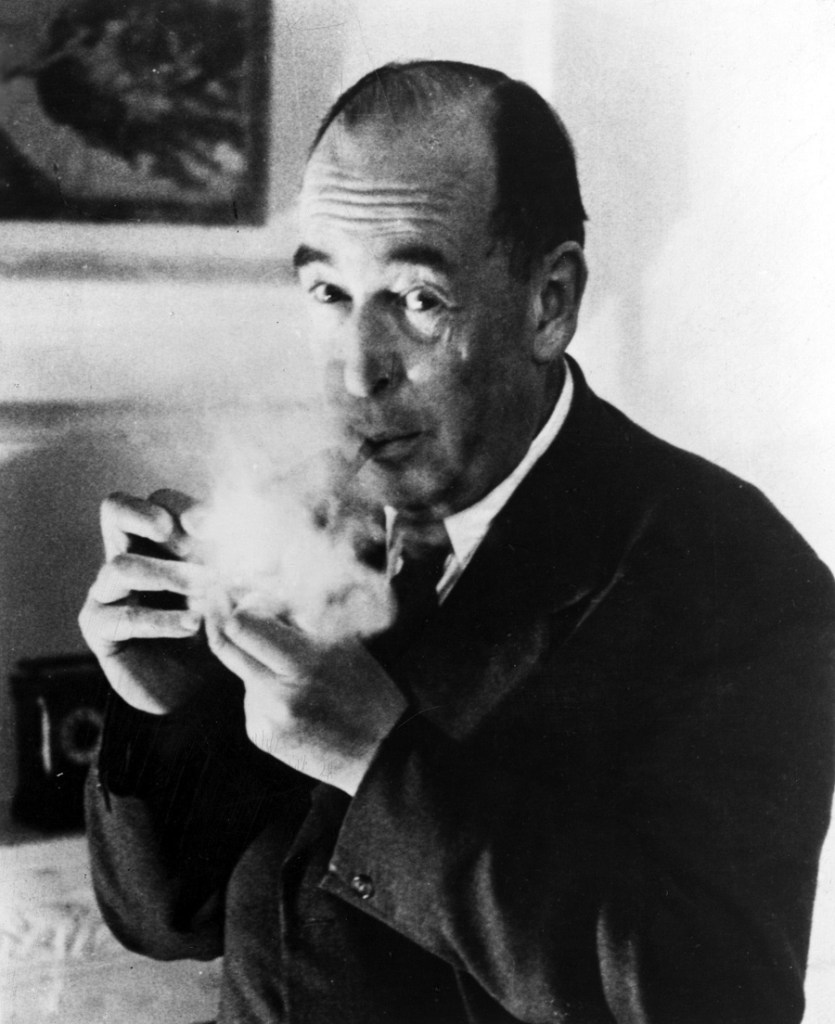
This was something that Lewis shared with J.R.R. Tolkien and G.K. Chesterton. They did not think that they needed to give up the joys of life in order to be good, solid Christians. Tolkien himself found the joy of God through his family, and he wrote literature about elves and dwarves and hobbits to show his appreciation (and to practice adoration) of God in the otherwise mundane world. Chesterton also enjoyed adoration of God through beer and boisterous conversation, but also things like smoking cigars as well. I have asthma, and I’ve never liked the smell of smoke, so appreciating God through cigars sounds to me like loving Jesus by walking on sharp stones on a hot day, but hey, I enjoy God by translating Old Welsh nature poetry, so who am I to complain?
The point of adoration is not just to enjoy something, though. Anyone can enjoy a bowl of ice cream or a walk in the woods. Adoration happens when we feel the epiphany of each moment and the created life in the things that we enjoy. Maybe this sounds like work to you. Why can’t you just enjoy something? Why do you need to enjoy something and think about God all the time. Doing this reminds me of my students when I taught literature who complained that I was “ruining” the stories we read by asking them to think about setting, plot, and character as they enjoyed them. But I think my students just hadn’t learned how to do it yet, because part of a mature reading of literature is to look for and love the way a plot is written, how a setting is established, how characters become fleshed out. At least, I think so.
Lewis goes even further, however. For him, the reception of pleasure and the recognition of its origin are one and the same thing. Putting your feet into a pair of comfortable slippers is the same as knowing, in your gut, that God made a world where comfy slippers exist. Glory be to God for dappled things, as Gerard Manly Hopkins writes, and his cry of “glory” is the same action as his seeing dappled things.
I feel this way when I receive the Eucharist: I know that it is God’s Body and Blood, but I also taste and enjoy the bread and the wine (another reason why we should use yummy, baked bread instead of wafers). Maybe you do, too. But what if we enjoyed everything given to us by God in the same way? What if we recognized the origin of the trees, the wind, coffee, a good book, looking up at the night sky, spending time in the middle of the day doing absolutely nothing – what if we recognized these as literal gifts from God in the same act as enjoying them? Doing so requires a lot of time in prayer practicing how to listen and to speak at the same time, and how to look to God and be ourselves just as we’re being emptied and filled by our Creator. But when we open ourselves to the universe within each of our acts, we can live to God (as St. Paul writes) without changing much of what we do each day. We can become living adoration to the divine.


Leave a comment