This morning, I joined my church in the rather mundane chore of raking our parish cemetery, though I was met with the rather singular experience of pulling away a thick layer of leaves to find gravestones from two hundred years ago. It’s not surprising to find gravestones in a cemetery, of course. Christ Church is over two hundred years old, too, and so it’s normal to find a stone marking the resting space of someone who lived during the Revolutionary War. Many parishioners and people in the area love to walk in the cemetery for just this reason: to see all of this history in their own town (and sometimes in their back yards). History connects people, helps build in them a sense of their own identities, and is just plain interesting to explore.
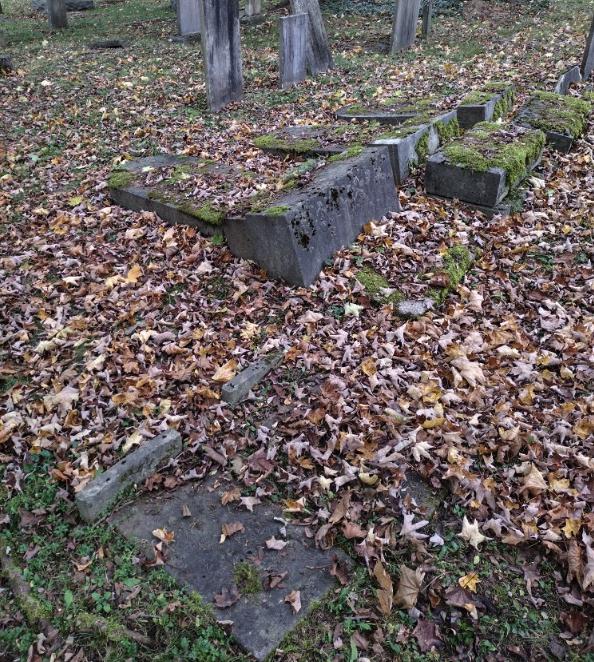
All of this (and more) struck me rather beautifully when, as I was raking, pulled away leaves to reveal these gravestones. Raking is hard work. The leaves were wet and a bit heavy, and as you pull them along the ground, your rake gets caught up in the long grass and the tree roots that you can’t see. But as I was pulling, and as my rake was being pulled back by the grass and roots, suddenly there was the sound of plastic against old stone and my rake glided rather easily across a wide, relatively smooth surface. The stones I uncovered were large, too: maybe about two feet by four. They were embedded in the ground, having either fallen there or been placed there to mark the grave of someone who had been loved, then lost, then remembered. Weather had taken its toll, and so I couldn’t read anything at all of the inscription, leaving the stones to seem just as natural a part of the land as the dirt and grass and roots.
The experience felt, in a way, like finding a stream on a hike through the forest, or, like when you’re driving on a lonely highway out west and discover a river or an open plain when curving around a bend in the mountains. It was more than this, however – or at least different, because there was also the undeniable stamp of a fellow human being inherent in the discovery. It felt like nature suddenly glanced up at me, though “nature” had both the eyes of a human and the body of stone and leaf.
Another gravestone was similar but different. This stone had fallen over but was thick enough (or young enough) that it hadn’t yet been drawn down into the ground. There was moss all over it, and after scraping the moss away, I found a single inscription: FATHER and MOTHER written in a lozenge shape, almost like an eye. The names of this father and of this mother may have been written on the other side of the stone, but all I could tell was that this couple, these parents, were remembered together. Their names were lost to history. How they lived their lives had died, perhaps, with their grandchildren or great-grandchildren. Now, on earth, they were only remembered by this stone and their beloved designation as “father” and “mother.”

These sights and simple meditations struck me, and I wonder if, perhaps, they did so because we are celebrating the Feast of All Saints tomorrow morning. In this season of autumn, we think about death – the death of the world to winter, the deaths of those who went before us (and especially those who died this past year), and even our own future deaths as well. Ancient Celtic and Norse peoples (among others) thought this time of the year to be a “thin space” – which is pretty amazing if you think about it. Most of the time, we think of “thin spaces” as actual spaces; but there were cultures, and there probably still are cultures who consider entire seasons to be thin spaces. The distance between this world and the next (or the “other”) is lesser than in the summer with its bright sun or the winter with its silence. We Christians live in that thinness now in the time between the Feast of All Saints and the liturgical season of Advent. And this morning, I experienced that thin space in uncovering these gravestones and hearing just a whisper of the past.
The world is permeable. We think that we all are distinct individuals, that we make every single of our own choices, that we are self-made people. At least, that’s what we often think in the United States or are told by popular media. But that’s simply not true. The world is permeable. It’s translucent. It’s full of holes where we are touched by the worlds beyond us and where we touch other worlds as well. Our religions teach us to navigate that space and that permeability, both so that we can learn wisdom from touching them and so we can understand more of who we are as people. For Christians, the Eucharist, the Blessed Sacrament, is that moment of ultimate permeability, when God descends to live within us so that we might ascent to God. But we find these connections in places much more mundane than the Heavenly Banquet; we also find them while raking a cemetery.
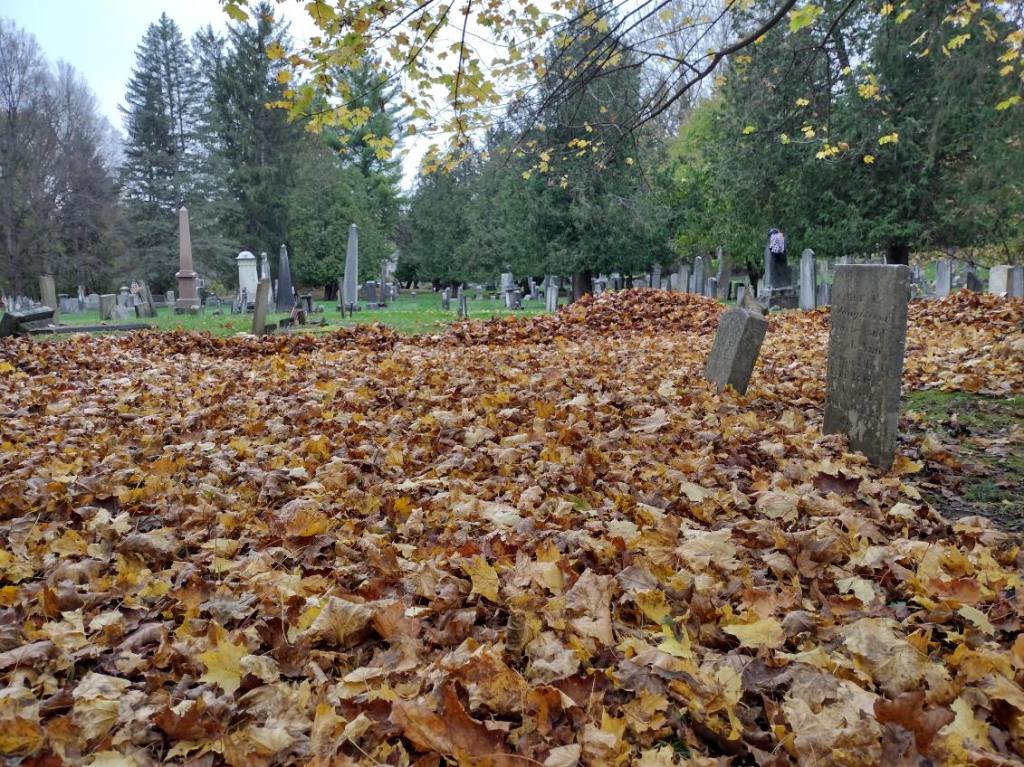
The world is a place to uncover. Sometimes it’s the world that we uncover. Sometimes it’s the hearts of those around us. Sometimes it’s a stone that speaks – without words – of a person or a couple who lived before our country was even born. Sometimes we uncover God. Sometimes we uncover ourselves. Whatever the case, I think it’s important to step back a moment and marvel at the sheer gift of uncovering, of discovering, of revelation.

 Incense and Crayons
Leave a reply to Jean Stephanie Cancel reply