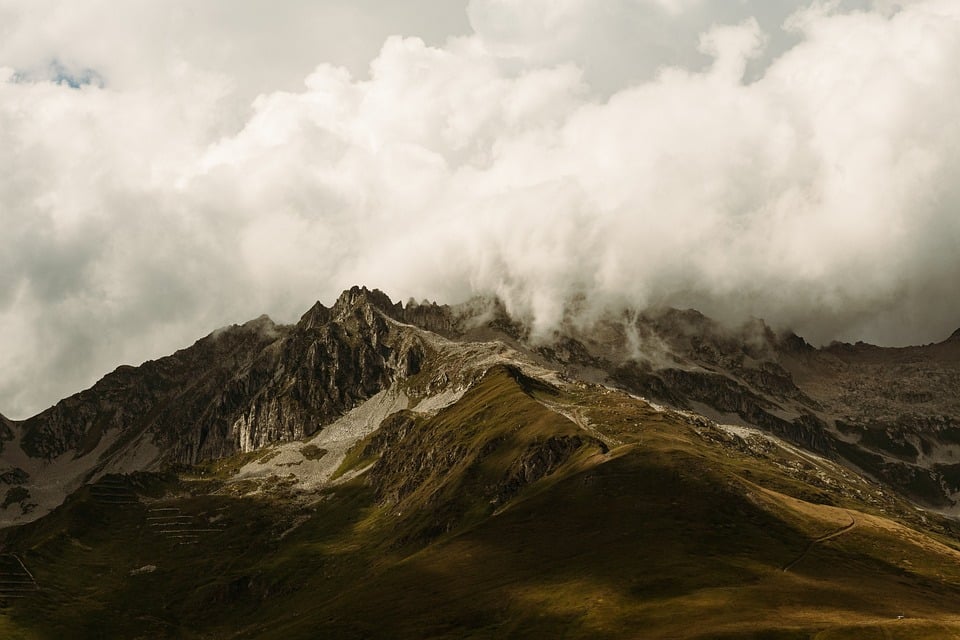
“Prone to wander, Lord I feel it. Prone to leave the God I love.”
“Not all who wander are lost.”
Two very different views of wandering! The first quote is from the hymn “Come thou font of every blessing.” If you don’t know the tune, you can find a nice Celtic version here. The second quote is from a poem by J.R.R. Tolkien in The Fellowship of the Ring. Here’s the stanza it’s from:
All that is gold does not glitter,
Not all those who wander are lost;
The old that is strong does not wither,
Deep roots are not reached by the frost.
While I was raised in the Church, very little of it reached and affected my imagination, and so I heard and contemplated Tolkien’s line first. The whole poem struck me, especially the lines quoted above. They seemed somehow important, somehow essential to realizing the deep wisdom of the world. After studying medieval literature, I found out that they’re basically in the form of wisdom literature, specifically a form called “gnomes.”
No, not garden gnomes, but wisdom gnomes. Gnomes were originally creatures of intelligence and knowledge (both “gnome” and “to know” have the same roots etymologically). And outside of popular culture, and in nerd culture, they still are. Gnomes in Dungeons & Dragons are artificers who make mechanical wonder, because they bear ancient knowledge.
Gnomes are also short, pithy sayings that communicate some wisdom or knowledge. They’re like common sayings such as “When it rains, it pours” or “A bird in the hand is worth two in the bush.” Gnomes state facts in short phrases, and Tolkien’s gnomes are kind of backwards: they state facts in the negative to make them more interesting, encouraging us to seek out examples of things that glitter like gold but aren’t, or that which is old but also still strong (for Tolkien, the answer for this always involves trees).
For a long time, I called myself a wanderer. I still do, and in very much the way that Tolkien means in the poem: I wander, but I’m not lost. I just don’t always see the purpose of having a clear destination in mind, and I rather like the idea of an open-ended journey.
When I began to return to the Church, or, really when I started learning the traditions of the Church at all, I found that the act of wandering is not always looked upon favorably. “Prone to wander, Lord I feel it; prone to leave the God I love.” Does wandering mean that I’m leaving God? And sheep wander and go astray; but are all wandering sheep going astray?
The answer to these questions is a healthy dose of “yes” and “no.” When Christian hymns and Jesus talk about sheep going astray and we humans wandering, what they really mean is that we’re often distracted. This morning, while praying silently about my relationship with God, my mind suddenly caught upon an old memory and played around with it for a while, feeling awkward about it but also reveling in the distance of time. Then I remembered that I was supposed to be praying, and praying silently, and that maybe I should keep such reminiscing for later! I got distracted, and so I needed to return my attention to God.
There is also distraction that is a bit more insidious. We can be distracted carnally, with the world of things, the culture of the world, with sex and gluttony and violence. Not all of these things are bad: violence certainly is, but sex is often disparaged in a very puritanical and unfair way. But we can certainly sink ourselves into the ups and downs of the political sphere, or get caught up in sports or video games to the detriment of our other responsibilities, like caring for our children or working for the benefit of the poor and the lost. These kinds of distractions can keep us from really hearing God and hearing one another.
I think Christians can readily understand what I mean by distractions, even if we disagree about what kinds of things are distractions and which are just plain fun and good for the soul. Wandering away from God makes sense. Wandering as a good thing, however, may be harder to grasp. Especially where I live in the northeast of the U.S., wandering can be misunderstood.
There is simply too much to God’s Creation. Let’s start there. God’s Creation is broad and wide and I feel like I could happily live my life studying each and every part of it. In undergrad, I couldn’t settle on a major for a while, because I wanted to study so much: literature, philosophy, history, different cultures and languages. After a while I had to settle on something, but when I did, I found that there were still further and further depths. Focusing on Japanese culture, as I did, only showed me how deep and intricate the language, history, and culture of this people is. You need to learn more about linguistics if you want to love the Japanese language more fully, and there is so much literature and poetry and people writing about literature and poetry and the tea ceremony and flower arrangements and puppeteering, and that’s all just to answer why Japanese video games tend to have stories about travelers (I still haven’t gotten to the bottom of why this is the case). It’s all so interesting, and at the end of the day, why choose?
There’s something else about wandering, though, and it has to do with our relationships with God. After many long hours of wandering through God’s good Creation, there is a sense that none of it is enough. You can’t put your finger on it, but suddenly everything seems to fade away in the background and the presence of the Lord comes upon you, attached to nothing that you’ve been studying but not denying it either. It is the great mystery that is beautiful and wonderful and distant and strange all at once, and it has nothing to do with deadlines or committees or twelve-month plans. There is no goal or focus, because God is everywhere around you and within you. And the only thing that you can do is just wander within God.
It’s hard not to have a destination. It’s not easy to live without a focus. Sometimes life seems like being tossed around in a storm, not knowing which way is up towards the air or down towards the dark, endless depths of nothingness. In God, however, wandering has a focus while also allowing for a broad vision of all things. Wandering is like being in calm water that is warm and good and nourishing. We are sustained in God so that we may seek after whatever way the Holy Spirit blows in any particular moment. All we can do is wander through such a landscape.

 Incense and Crayons
Leave a comment