
When my daughter asked me “But what IS Halloween”, I realized that I had two choices. I could focus on the purely secular holiday, or I could focus on the religious aspect. I could do both, of course, but my daughter asked me in the kitchen as we were getting ready for school, and so I didn’t have a ton of time to discourse on the depths of the tradition. The choice, however, seemed pretty stark to me then, and that’s partially because the secular and the religious are merged in our house, as they are in many religious families.
I’m a millennial, and so I grew up in a secular culture. The stories we were told were on TV or at the movies. When I think of my childhood, I think of the Teenage Mutant Ninja Turtles and Disney’s Aladdin. I heard stories about Moses, Joseph, and Samson in church school, but they didn’t resonate with me, nor did any of the other kids in my neighborhood talk about them. I learned about the potential depth of stories from video games (I’m serious) like Chrono Trigger and Xenogears, and I was challenged morally and socially by anime that I watched in high school. Jesus’ teachings were in the background of all this, but they weren’t in anyway at the forefront of my mind, nor did they have an effect on the choices I made. Maybe this just means that I didn’t have a very strong Christian upbringing, but I remained Christian throughout it all and never felt that my secular enjoyments challenged my faith. (Actually, the only thing that ever really challenged my faith was when I heard that, for some Christians, biblical faith and queer rights weren’t compatible)
I don’t write any of this to suggest that having a secular upbringing was anything bad. Personally, I think that anime, video games, and Saturday morning cartoons prepared me for a creative, dynamic, introspective, and compassionate faith as a mature Christian. I do think, however, that I missed something in not having a more robust Christian upbringing. I think I’d have a better relationship with the Old Testament and, through it, the New Testament letters. I also think that I would have moved to a liturgical tradition earlier and would have found much solace in it, especially while living abroad in Japan. And so, as I move from the role of learning child to teaching parent, I hope to instill in my children a greater depth of their tradition as Christians, even as we talk and play quite a bit of Pokemon and Sailor Moon.
And so it was something of a surprise for me that, when my daughter asked what Halloween was really about, I was somewhat conflicted. I’m not the type of Christian that wrings his hands over “secular” holidays like Halloween, and I’ve never really understood some Christians’ dislike of Christmas, which to me seems to be one of the greatest gifts we’ve given to secular culture. There is, however, a thinness to the idea of “we get dressed up for fun” when compared to the depth of All Saints Day, All Hallows Eve, and the Celtic celebration that gave its own gifts to the Christian tradition. The answer to my conflict is, I think, in just this combination of pagan underpinnings of a Christian celebration.
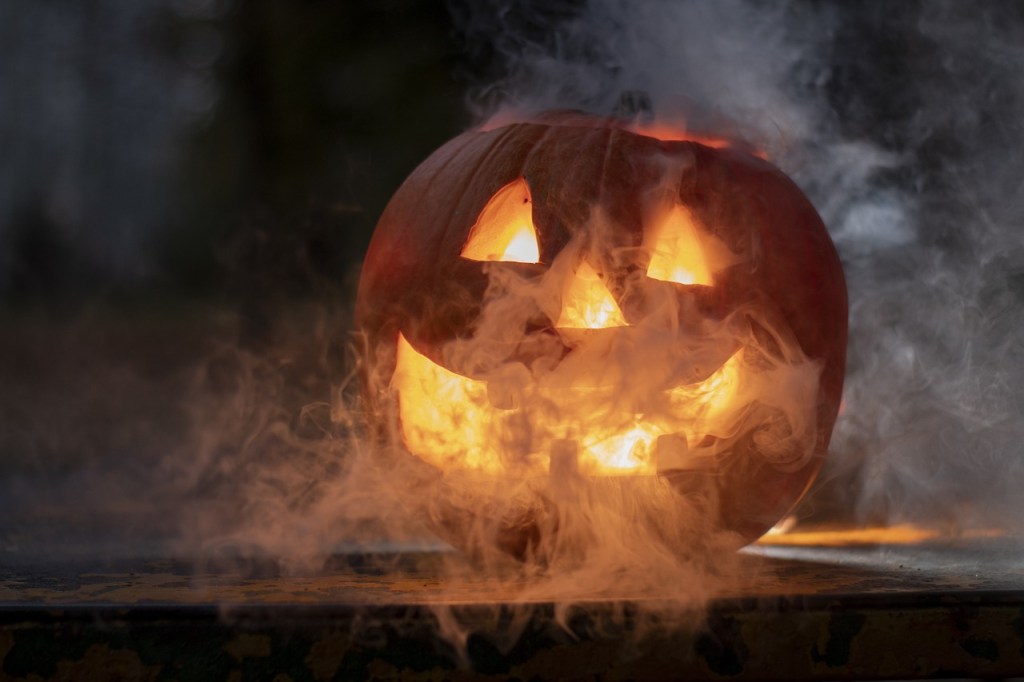
Halloween is a Christian celebration. The word itself comes from “All Hallows Even”, which was shortened in the original Scots dialect to “Hollows e’en”. The celebration is a vigil, actually, before the “hallowed” or “holy” day of All Saints’, when we remember those who have died over the past year or whose death remains particularly close or painful. The holiday grew from an earlier Celtic, pagan holiday that marked the end of the year. In this pagan tradition, the ends of old things and the beginnings of new things left a gap; the new year didn’t just start as soon as the old year ended, like it does on our modern New Years’ Eve. And this gap allowed for strange things to happen, many of them mystical or spiritual, and in this case the gap allowed spirits from all different places (both the dead and malicious spirits like elves) to cross from their world into ours. Many traditions grew from this belief to counter the malicious influence, such as remaining in prayer with family, leaving water bins in certain places, and not opening the doors for mysterious guests who came a-knocking.
Now, we know about these traditions not from pagan sources but from Christian monks (we actually have almost nothing written by pre-Christian pagans). Paganism in the British Isles was pretty much dead by the time vellum books came into general use, though, just like in our modern culture with Christianity, many pagan traditions continued even though the isles were completely Christianized. We in the 21st century try to see paganism and Christianity as opposites, but the truth is that they melded together quite naturally, usually with Christian teachings being celebrated in pagan form (think of Christmas trees and wreaths). Medieval Christians didn’t want to give up their family traditions, and so they didn’t, and they lived quite happy lives this way. Evidence of this synthesis can be found in monasteries, the centers of Christianity during these times, where monks would copy down pagan stories (be they Celtic or Norse) and revel in their telling, then hop down to the chapel to chant the offices and read the Bible. This wasn’t a problem for them, which suggests that living in the secular world and the religious world shouldn’t be a problem for us.
The problem we face in the modern world, then, is that we teach and practice the secular without really getting down deep into the religious. We dress up as scary ghosts or zombies (or, for my girls, cute woodland animals), and we decorate our lawns with skeletons and jack-o-lanterns, but do we actually spend much time talking about the dead? As a priest, I’ve seen people break down in tears when they learn that we’ll be honoring their parents or grandparents (or children) by reading their names on All Saints’ Day. There’s a need for this kind of stuff – not just decorations that can be put away but real interaction with the grief of losing people that we love and still living on. And, AND, continuing to live on in their presence, because Christians believe that the spirits of the dead DO in fact come back, not just on this single day of the year in early November but all the time and, especially, in the Most Blessed Sacrament of the Eucharist. There is real healing and true communion in those days that lead to healthier lives and experiences of the fullness of reality. To keep any of that from people just sounds wrong to me.
So, in the end, what did I say to my daughter. I told her that Halloween and All Saints’ Day is a time when we remember those who have died and remember also that they are still close with us. Getting dressed up is a way to remember that, just as reading names of the dead this Sunday will be a way to remember that. My thought was, she already has enough exposure to the secular parts of Halloween; it’s my job, in that moment and beyond, to address the other aspects.
What do you think? How would you have answered the question from a six-year old little girl? What things do you focus on with your children or did you focus on with your kids when they were young and asked similar questions? Feel free to comment below.
P.S. – for more information about the linguistic origins of Halloween, go to etymonline.org. It’s a great resource that cuts through some of the popular (and usually incorrect) explanations of the interactions between paganism and Christianity in the medieval world.

 Incense and Crayons
Leave a comment