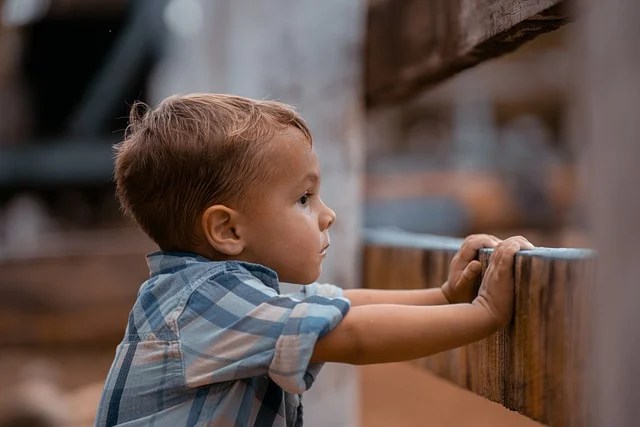
I enjoying hearing what children think and feel about religion. Or, to be more specific, I like to think of questions to ask children about religion, and I like to talk with them about their answers. I was in academia for ten years before I became a priest, so I guess I still have something of a research mentality in me. I like seeing children’s minds work, and I especially like to see which words they use for their religious experiences. In my experience, adults usually consider their words when describing spiritual matters, whereas children just use whatever word they think of first.
Luckily, I have two children of my own, so I get to ask them questions about God whenever I want. And they’re usually pretty responsive, especially if I tell them that I’m going to write about our conversations here or put what they said in my sermon (they love hearing about themselves in my sermons). I’d like to talk to children about God and religion more often, and I’d like to talk to children besides mine, who I’ve helped to shape, but for now my children are willing and eager, so why not.
So here is some of a conversation between myself and my nine-year old daughter. I asked the questions and let her talk through her thoughts, and I tried to direct her as little as possible (unless she asked me a question herself to clarify what I meant). My general intent was to learn a bit about how children, and my daughter specifically, processes things like church and prayer. Also, my wife helped me frame these questions; she’s trained as a children’s librarian and is now my parish’s Children’s Education Director, so she knows more than I do about how to ask questions that children will understand.

My first question was: When do you think about God?
“When I’m calm about something. When I’m not really frustrated about something, I think of God.”
This answer surprised me, and so I asked a further question: “What kind of things do you think about when you think about God?”
“That’s a hard question.”
I probably should have delved a little deeper into this and asked her why, but instead of tried to rephrase the question. I asked, “What do you feel about God?”
“Sometimes I feel, like, happy. Sometimes I think about Jesus when he died, so I sometimes get sad about that.”
I think this is a really interested response. It’s very much a response from my daughter, who is a very kind and thoughtful little girl, but I think it’s a response that many children have. Jesus is at the center of our religion, and we Christians say two things about Jesus: one is a wonderful thing and the other is a terrible thing. First, Jesus is love, he loves all of us, and he is always with us. But also, second, Jesus died on the cross. Adult Christians live with the tension of the cross and the empty tomb, but so do children.
I’m not sure if it’s appropriate to try and repair that tension. I believe pretty firmly that adult Christians need to hold that tension, and that we exist within that tension, as we contemplate the reality that God as Jesus Christ was killed and yet through Jesus’ death and resurrection we are granted eternal life.
But what do we do with that tension for children? Well, maybe an analogy will help. We don’t live close to my parents or in-laws (our closest relative is four hours away), and so we often talk to the children about how wonderful it is to see grandparents, aunts and uncles, and cousins, but also how it is difficult to be apart. This is especially the case for when family comes to visit and then has to leave.
For these times, we usually talk about loving our family and how that love doesn’t change even when we aren’t in the same room or the same house as that person we love. In other words, we ask our children to live within the tension of love and, at times, separation. It’s healthy, I think, to live within that tension, especially by focusing on the continuity of love over distance and time. The tension does not break that love, nor does it challenge it, because (as the Church teaches) love is greater than everything else. Even death cannot conquer it – in fact, love conquered death on the cross.
One thing to consider in all this is how we adults talk about this tension while children are around. And they are around often. At least at my church, for high holy days like Christmas and Easter, we don’t have Sunday school. Children are in the pews with their parents. And as my daughter noted in another answer later in our conversation, kids are always listening.
Are our liturgies drawing people into that tension and then out again in love? And do we make one of them accessible to children and another not? My worry, of course, is that we make the tension open to children but hide the love part in ways that only adults can really understand. When looking at how we celebrate Christmas, Easter, and Communion, are we demonstrating God’s eternal love in non-verbal ways (which are often the ways that children most fully understand what a liturgy is trying to say)? Children are not the only group to consider when thinking about liturgy, but they’re an important group.
Well, one question led me to write quite a bit, so I’ll leave the rest of the questions for next week. I think this is enough to chew on.

 Incense and Crayons
Leave a comment