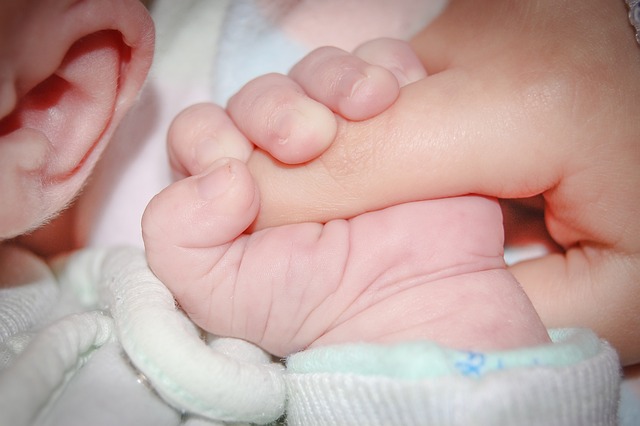
Just before my first daughter was born, a friend gave me a small book called “Holding your baby.” It was a book of prayer and devotions to be read by a parent in the first days of their lives. It really was a small book, more like a pamphlet than anything else, which was perfect for holding when I needed both hands to cradle my daughter. I don’t remember much of the content, but I do remember the general message of the book: hold your child as an act of prayer.
These days we might say something like, “Hold your daughter intentionally”, but I’ve never personally liked the word “intentionally.” It doesn’t get deep enough for me. Intentionality seems like a mental activity, not a whole-person act. It’s not an act of being like prayer is. When we pray, we turn our whole self (from our attention and our heart to the very motes of our physical body) towards God. Prayer catches us up in a gravity that pulls us down towards God instead of towards the center of the Earth. Prayer is conversation, communion, and community that requires the whole self.
So how do we hold our children as prayer? It’s hard to describe with words, but I think everyone who has ever held their child in love knows what I’m talking about. For me, when I held my daughters in prayer, and when I still hold them in prayer even now when they’re five and eight, I feel a sort of “spiritual sensitivity” in my arms and my chest. My hands and arms become, somehow, more real than they were before. And, if I let the feeling follow its natural (or supernatural) course, my whole body feels more alive, and the chair I’m sitting on or the air I breathe seems to come alive as well. Everything becomes as it “should” be. I live no longer in a world that seems to simply exist but one that is filled with goodness and joy. I, too, become who God has always intended me to be.
One of the magnificent parts of this is how passive we are in all this. We don’t have to do anything in order to be who God has always intended us to be. We simply hold the child and experience eternity.
What else do we hold this way? Unfortunately, not much. I think that we use other senses to pray pretty often: we listen to beautiful music (inside or outside of worship services), and we look with love at the beloved people in our lives or at holy vessels or icons used in prayer. We may revel in the smell or taste of delicious food. But what about the sense of touch? We can pray while we walk, which is similar to touch but may be that sixth sense of our body in space (also called proprioception). I’ve prayed while making bread, a process that includes touch, and I think the bread tastes better when it is made in prayer. But what about holding, specifically holding, as prayer? When do we hold things for long enough to pray with them?
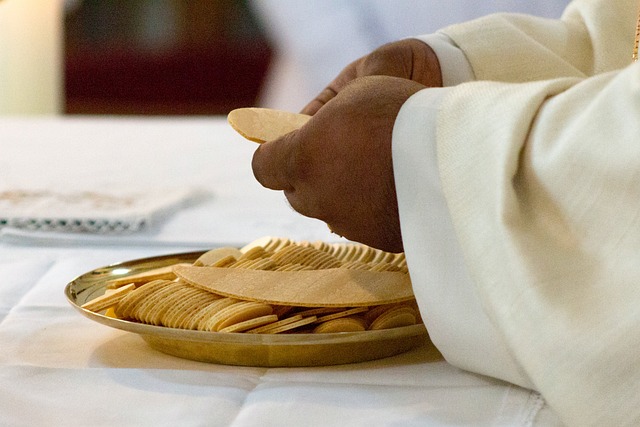
For Christians who celebrate the sacrament of the Eucharist, and especially those who believe that Christ is fully present in the Bread and Wine, holding the Elements is often prayerful. Each week, I place the Bread of the Most Blessed Sacrament into hands outstretched in prayer. It’s hard to convey how beautiful this is. I think of it as one of the most precious blessings of my life as a priest. I am invited into a moment of prayer in which a person and God commune with one another, and I have the extremely humbling role of placing that connection into a person’s open palm. Whether it’s the palm of a little child, who I then teach to say “Amen” or a cradle Episcopalian who can’t kneel down anymore but whose hands have known for almost a century the weight of the glory they are about to receive, the gift of distributing Communion is the most precious in my ministry.
I also hold the Bread and the Chalice in prayer for myself. During the pandemic, I made it a practice to commune myself last to avoid any germs, and I’ve kept up this practice as a habit. It’s also more polite and hospitable, I think, to distribute Communion to others first and then receive last, but there’s also another reason. I want to savor the Sacrament. I want to remain there behind the Altar and not worry about other people waiting on me so that I can hold the Bread, reverence it with a kiss, and partake of Christ’s Body and Blood at my own pace. In other words, I want to receive the Eucharist prayerfully.
I don’t think that I would know this prayerfulness in receiving the Eucharist unless I had held my own daughters in my arms. And in saying this, I don’t mean to suggest that in order to really know how to hold the Eucharist you need to have first held your own child. That’s absurd. God teaches us how to love through each of our lives individually and communally. Those who don’t have children, who can’t or are scared of holding babies (they really are fragile!), or for whatever reason just haven’t had the chance to sit with a baby in their laps, God teaches those people how to love and pray through holding in different venues. For me, though, God taught me how to receive the Eucharist through holding my children. And for me, that really is the greatest gift: that my daughters and the Eucharist are so beautifully intertwined. It’s something I give thanks for every time I reflect on it, and I want to reflect on it more often.
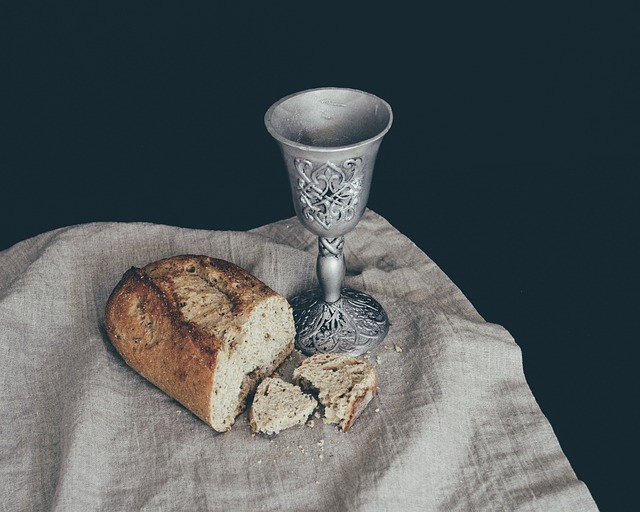
Reflecting doesn’t just lead me to thanksgiving (which would be enough, of course), but also to wondering how to hold other things prayerfully. If I wrote about this topic, though, this post would never end, and so I’ll finish here with a question: what if we held all things, especially other people, as lovingly and as prayerfully as we hold our children and as we hold the Sacrament?

 Incense and Crayons
Leave a comment