Conversion is never one hundred percent. We always bring something with us when we make a change (or changes are made) to our lives. To put it into even more Christian language, the death and resurrection that we experience in coming to Jesus Christ and in carrying our cross is not a complete death, though it certainly is a complete resurrection. We don’t start with a blank slate when we die to ourselves and rise to God in Jesus Christ. Something dies and that something is resurrected as a fuller version of itself. Remember that, even after Jesus was resurrected, he still bore the wounds of his torture and crucifixion.
This can be a good thing and it can be a bad thing. On the one hand, just because we’ve been baptized or vow to follow Christ as our Lord forever, that doesn’t mean we won’t sin. Those old hurts are still there, much to our grief. Being washed of our sin doesn’t mean that we don’t have to work out whatever pain our sins caused. Actually, it’s quite the opposite: as Christians baptized and receiving the Sacraments, the results of our sins are only more fully before us, and the Spirit urges us all the more to seek reconciliation with one another and inside of ourselves when God makes a holy garden in our hearts to walk through.
All that said, I want to write today about the good things that pass through our death and which are resurrected. These good things tend to be the things we love most: our families, our beloved hobbies, the important – even essential – things that we were taught by our mentors, and so on. The “death” that is conversion does not simply transport them from our old lives to our new lives. No, they really do die and really are reborn. They pass through a purifying fire and are made more holy. Or, perhaps it is more accurate to say that they pass through a purifying fare and are offered to us again in their now more holy state. We always have the free will to accept this new state or to reject it and return to the shadow of who we used to be.
For me, one of the major “good things” that passed through death and was resurrected with me is my writing. I have written creatively since I was in elementary school. I remember making little hand-crafted books with my sister when we were young. Most of them were about kittens or puppies lost in the woods, though I was also enamored with fighter jets after watching Top Gun. My cousin Michael taught me how to draw planes, and I was always proud of how well I could draw them flying in the sky and exploding. Even then I was curious about death, so that in each book I wrote, even if it didn’t have fighter jets, Goose from Top Gun always died (or, as I wrote with my horrible spelling, “Goos did.”)
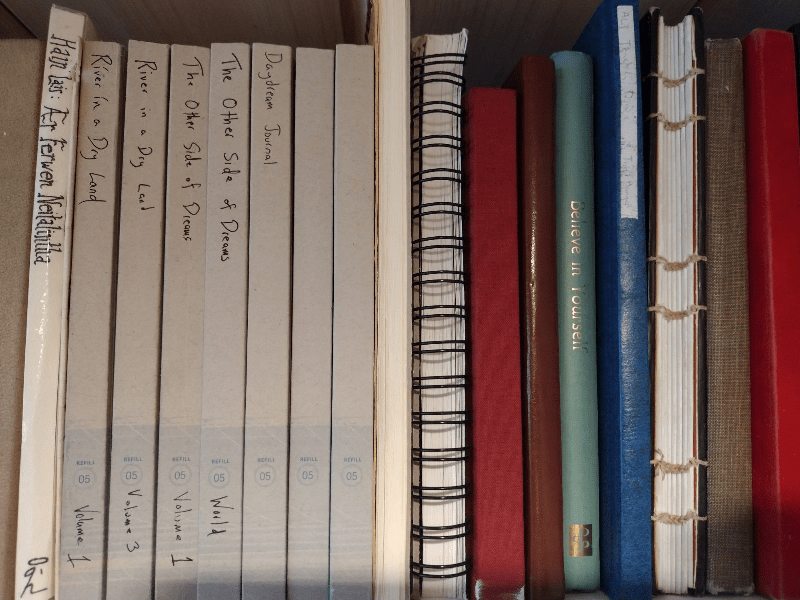
I continued to write into middle school, when I wrote my first full story (now lost) about aliens attacking Earth, then got serious in high school and college, when I followed J.R.R. Tolkien in writing my own mythology and languages. I had a forty minute bus ride to and from school, and I remember gazing out the window each morning and each afternoon, watching the forests and houses pass by, dreaming of some story and searching for mysterious creatures among the trees. I continue with my myths in my recent novels, and I’ve pulled many of the dreams and imaginations from little Timmy on the school bus and matured them into the different philosophy, theology, and life experiences that I use to write now at forty-one years old.
Something has, however, changed, and it’s not just that I’m a bit more mature now than I was in high school. I don’t just “write better” or have a broader concept of what it means to write and what it means to be human. Something changed at three important points in my life: when I began to take my communal faith seriously, when my wife and I had our first child, and when I was ordained to the priesthood.
Were these moments of conversion? Not in normal parlance, but I did make a transition from one way of living to another. I wasn’t “converted” by someone preaching to me the “good news.” No, I was converted by the Spirit directing my heart and my spirit within these three major changes. Parts of who I am as a person died and were reborn, and the Spirit brought them to my attention by saying, “Look. Look! This is who you always were! Now these parts of you are subsumed into God’s eternal Love for the deepening of our relationship and for the healing and reconciliation of my beloved people.” If that’s not conversion, I don’t really know what is.
The important point of these three moments of conversion was not the fact that they happened but the character of the death and the resurrection – and these characters can be found in how my heart feels when I step into the act of writing. For example, holding my children as babies changed how I held the very act of writing. There is a gentleness that I experienced when my daughter was first laid into my arms. There is a belovedness, a care, a responsibility, a tenderness that I felt when holding my first daughter and then again when holding my second daughter, both of them at the time just seconds old. And that beloved care, that tender responsibility, that gentleness, extends to how I hold sentences, how to discern which word to use, and how I see myself after having finished writing something – be it one of these posts, a sermon, or a scene in one of my novels. Of course, I still struggle at times. I still fight myself and seek out what God wants more than what I want, but there is a different tenor to the battle now. I know how to hold something (someone) who can break so easily, who needed me desperately to hold them up from falling and to show them what love means in a world filled with so much hatred. I hold a sentence, I hold words, I hold my writing in that same way now, because who I was as a writer died and rose from the grave.
Is that not miraculous? I can think of few greater miracles that I have experienced in my life (though it must be said that miracles are not as rare as we sometimes make them out to be). Thinking of holding my children and holding my writing gives me great hope for both, and it gives me great hope for our world – because God is helping us to die and leading us to resurrection in all things, not just the things we don’t like, not just the things we like. All of this is an experience that shows me that the cup of the world runneth over with love and care, that God is present in all our healing, is the eternal author of all healing and reconciliation. Isn’t that a great thing to know? Just from holding a baby we can know it. Just from allowing ourselves to die and be reborn (again, no rare occurrence) we can know it. We follow the Spirit and we see where God is bringing us with eyes open and ready and faithful, because the Spirit always leads us to the exact place and the exact person we need to be.

 Incense and Crayons
Leave a comment