Recently, my kindergartener had an assignment on traditions. She was supposed to choose a family tradition and create a project around it. When we asked her what tradition she wanted to choose, there was a moment when I seriously worried that she’d say something about Star Wars or Lord of the Rings instead of Christianity. She ended up going with advent calendars, but the situation gave me pause. What is it that we are passing down to our children?
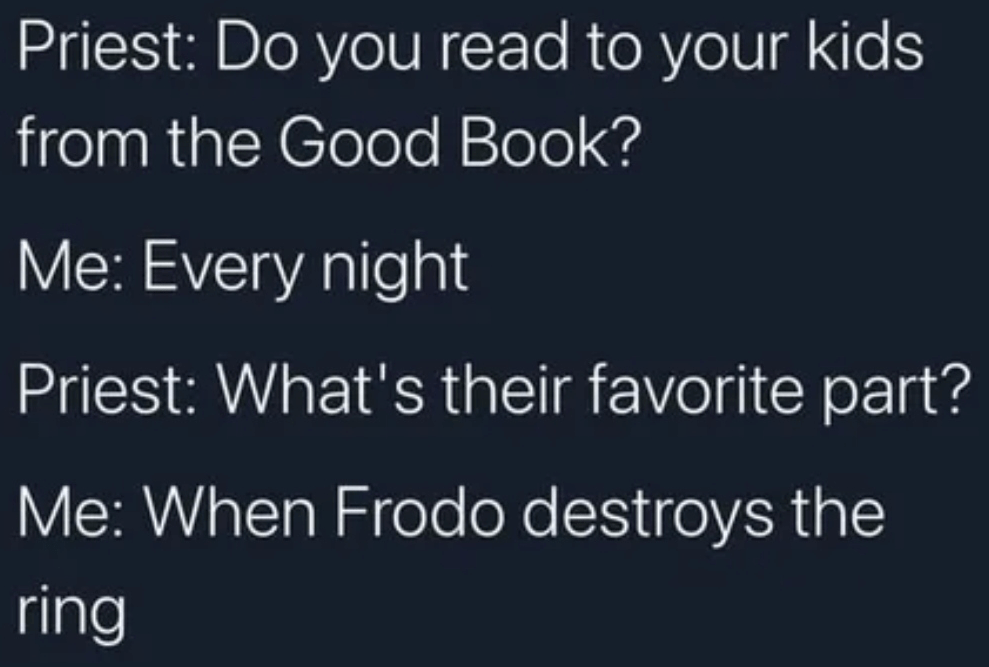
There’s been a meme going around social media (see the image on the left) about what the “Good Book” refers to. Of course, the traditional “Good Book” is the Bible, but as Christians live more and more with one foot in the secular
world, the contents of our tradition – what we pass down to our children – can become a jumble of secular, religious, and cultural values and ideas.
(by the way, Tolkien was a “staunch Roman Catholic” and would have been horrified to think of Lord of the Rings as a stand-in for the Bible. Also, Frodo didn’t destroy the Ring; it fell into Mt. Doom as an act of Providence laid down by Illuvatar, or God in Tolkien’s mythology)
I have to admit that there is a certain joy in reading Harry Potter and watching Star Wars with my children. These secular stories have been deeply meaningful to me, and they’ve been formative for me as a human being, as a Christian, and as a priest. I first began asking theological questions while watching Japanese anime, and my sense of the sublime was developed, in part, by Sigur Ros, an Icelandic band with some really wacky soundscapes. This year, my children watched me play Chrono Trigger, a game from the ’90s that some consider to be the best game ever made and which really shaped my aesthetic appreciation of music and narrative as well as my sense of justice. And I am proud to say that they loved the game and were as determined as I was to stop the bad guy from destroying time.

As human beings, we pass down different aspects and experiences in our lives to our children. We do this in the hope that they, too, will have the same deep and meaningful experiences that we did when we were children. These experiences, however, don’t always take place in church, or while reading the Bible, or while kneeling beside our beds in honest prayer with God. Often (and especially for us millennials), they took place in the storytelling center of our upbringing: on TV, in the movies, in games, and in sci-fi and fantasy books.
That said, “tradition” isn’t just passing down things that are important to us individually, and this is especially true for those who are in religious communities. I am, in a real way, beholden to my tradition to pass down the tenets, festivals, and practices of my religion. I’m beholden to this not because I want to indoctrinate my children, but because I’m raising them to be part of that same community, and being part of a community means knowing how that community lives together. And so advent calendars, receiving the Eucharist in great reverence, and making the Bible an important part of one’s life (and maybe even a daily part of one’s life) are all things that, as a Christian, I’ve agreed to make important for my children.

We arrive at an important question, however, when we ask how to (or whether to) distinguish between popular, secular traditions and those traditions of our faith. I pray fervently that my children continue to find great solace in the Sacraments until the day they die; I also hope that they discover music, secular or otherwise, that stirs their soul to the presence of God. I’d also love to grow up gaming with them. Is there a line to draw between these three hopes? Is there a difference in kind or degree between them? How do I form them in a tradition while, at the same time, allowing them the freedom to hear the Spirit outside of the red doors of an Episcopal Church?
One avenue to find an answer to these questions (and there are many avenues) comes from a conversation I had with a very good friend of mine. We both were formed as people on medieval literature and modern fantasy literature (including comics and games). We are also both Christians. A year or so ago, we asked one another the very important question: how is the Bible different than our favorite novels?
I admit that we struggled with this question. Books like Lord of the Rings or Crime and Punishment changed our lives forever. We are who we are because of them. They hold prominent places on our home bookshelves. And yet we both believe that the Bible is the inspired word of God. But how is the inspiration given to Tolkien and Dostoyevsky different from the inspiration given to St. Luke or St. John?
For some Christians, this may be an easy question, but it wasn’t for us. The Bible was written by the Church, not by God, in my opinion, and yet I revere the Bible much more fully and completely than I do Lord of the Rings. Are Tolkien’s works lesser? Was the Holy Spirit not as fully present in the life of Tolkien than He was in the life of St. Mark? How do I read the Bible as a book written and canonized by people while also seeing it as Scripture?

My friend had a good answer to these questions, and I pass this answer on to you as at least a starting point: we Christians base the center of our lives on the Bible in a way that we don’t other parts of culture. For my friend, this looks like reading the Book every day; for me, it is following an ordination vow to base my life and the lives of my family on the precepts found in the Bible. I’m not really sure what this means just yet, not fully, but I think it’s the direction of truth. While I’ve been formed by Chrono Trigger and Murakami Haruki, I feel almost created through the Bible. I know very well that I was created in the heart of God before the Bible was even conceived, but there is a special grace that flows through the Bible that acts towards the creation of a soul as God intended that soul to be created. In a way, I feel that this is an area of importance shared with other literature and art in my life, but it should be centered on the stories of Jesus and St. Paul and David in the Bible.
As you can see, this is an ongoing process. I haven’t fully figured it all out, but luckily we Christians aren’t expected to figure everything out to be saved. We are with God and beloved with God, whether we’ve finished figuring out our lives or not. Our work, however, with our children is to set them on a similar path: the path of being formed by the continuing questions of holding things like the Bible and the Sacraments in ultimate reverence and yet also adoring the secular works of art and tradition that we encounter. How to do that? Well, that’s also an ongoing process, but I know it’s the right one, whatever it comes across as looking like.

 Incense and Crayons
Leave a comment