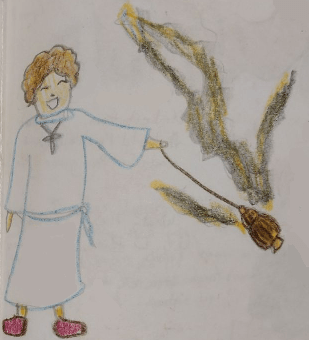
I had to celebrate my first Easter Vigil as a priest with my toddler daughter on my lap. I write “had to”, but that evening was one of my favorite memories as a priest and as a daddy. I had to do it, instead, because I really didn’t have much of a choice. As an Anglo-Catholic, I take the liturgy very seriously. It is literally the best thing in the entire world and the main instrument of grace by which God continues the work of creating and saving the world. And in the midst of this liturgy, even the Easter Vigil, what was once considered a Sacrament of the Church, I was not going to make a scene when my beloved daughter scurried up to where I sat in front of the congregation, the lights still off as we listened to the history of salvation, and demanded to sit with me instead of in the pew with her mother. And I didn’t just “let” her. I loved it. I couldn’t imagine a better way to celebrate Easter as a newly-ordained priest.
I was in seminary when my first daughter was born, and I was ordained a priest not long before the birth of my second daughter. Being a father (being a daddy) and being a priest (a different kind of “father”) have always been intricately intertwined for me. My identity as a priest and as a daddy have always overlapped. And both overlap with another of my identities: that of an artist. I’ve written fiction since I was in high school, but my writing blossomed as a daddy and as a priest: I wrote my first novel in my first daughter’s first year, and being a priest means writing a lot, and not just sermons every week.
Now, this triangle (or “trinity”) of identities is something that I find interesting, because I find meditating on them – each individually and all three at the same time – to be pretty fruitful. It’s fun to think about who we are as people. And yet, the more I practice my art, the more I serve the Church as a priest, and the more I raise my children, the more I see this very personal question taking on a social dimension – and, importantly, the more I see this question as being a ministry.

My job as a priest and my work as an artist are to help others see the world differently. Or, to put it in a way that includes my identity as a father, my work as a priest, an artist, and a father is to help others see the world – not differently, but to see it, to meet it face-to-face. As a daddy, I want my children to see the world not through eyes of fear, anxiety, or the simple dictates of our culture, but to see it as it truly is: as God’s beloved creation. In many cases, God’s creation (especially us humans) has gone awry and is twisted, but it remains,nevertheless, God’s beloved creation. As I tell my parishioners and my children, love is the lens through which we should engage any part of the world, be it other people or the natural world, because that is how God engages the world.
As a writer of fiction, and specifically a writer of science fiction and fantasy, it may be strange to say that I want to my works to help my audience see and love the world more fully, but it’s true. Wisdom about the world is more than just plain facts. Stories – good stories, at least – help us see, understand, and live within the fullness of the world around us, because most wisdom about the world cannot be explained didactically. It needs to be hinted at in a poem or experienced in a narrative. That’s one of the reasons why what people remembered most about Jesus were the stories that he told: his parables. It’s why all religions have, at their base, stories, and why, even in our secular culture, the stories that are the most popular have more similarities with myths and legends than works of high, classic literature. Stories tell us who we are and why we are.
In each of these identities, I hope for one thing: to help others see beyond the haze, frustration, anxiety, and lies that they are told and that they tell themselves and to see the world as God sees them. And as I write stories, as I pray and give spiritual care, and as I guide my children to be healthy, loving people, I have found that each part of my life comments on and helps to grow and deepen the other.
And so, my rather personal quest to figure out my own heart as an artist, a priest, and a daddy turns out to be something that involves a view of all creation. It is my hope that my contemplation upon the reality of living as an artist, priest, and daddy can help others in their own contemplation of themselves and in seeing the world more fully as God sees it.

 Incense and Crayons
Leave a comment